
The global development landscape is undergoing seismic shifts. As the United States signals its withdrawal from key global institutions and reduces foreign aid, Africa faces major implications for development agencies, donor-funded programmes, and especially its green economy and climate agenda. At a time when climate action and sustainable development are urgently needed, reduced funding from one of the world’s largest donors presents both challenges and opportunities, particularly for organisations and individuals committed to Africa’s low‑carbon transition.
Why This Matters: Funding Gaps, Climate Goals and Africa’s Needs
Africa continues to grapple with a significant climate finance gap. Despite recent growth, climate finance flowing to the continent remains far below what is needed to meet national climate commitments. Total climate finance to Africa grew to roughly USD 44 billion in 2021–22, up about 48% from 2019–20, but this only covers 23–25% of the annual financing required to achieve Nationally Determined Contributions (NDCs) by 2030. In practical terms, Africa needs roughly USD 277 billion per year for climate action, yet receives less than 5% of global climate finance, even though it contributes less than 5% of global emissions. This demonstrates both the continent’s vulnerability and the urgent need to mobilise alternative sources of finance beyond traditional aid.
Development Agencies and Donor Priorities in a New Reality
For African development agencies, reduced US aid and diminished participation in global institutions are likely to reshape how development and climate programmes are funded and delivered. Lower grant availability and reduced concessional lending may affect projects across renewable energy, climate adaptation, infrastructure, and agriculture. At the same time, donor priorities are shifting, with funding increasingly directed towards investment-ready projects that demonstrate measurable impact and clear alignment with climate and development objectives. This has intensified competition for limited financing, as agencies and organisations now compete for resources from remaining multilateral and bilateral donors, regional development banks, and private investors.
Multilateral development banks have begun to fill some of these gaps, mobilising USD 137 billion in climate finance in 2024. However, this finance remains unevenly distributed. Nearly half of all climate finance flowing to Africa is concentrated in just ten countries, leaving smaller and more vulnerable nations at risk of underfunding and exclusion from critical climate and development investments.
Employment Realities: Africa’s Workforce and the Green Economy
These funding shifts are unfolding against a backdrop of persistent unemployment across the continent. In South Africa, the unemployment rate stood at 32.9% in early 2025, with youth unemployment exceeding 46%. In Nigeria and Kenya youth unemployment ranges between 12.7% and 67%, with green economy opportunities still emerging but not yet at the required scale.
Despite these challenges, the green economy offers a clear pathway forward. Across Africa, sectors such as renewable energy, climate-smart agriculture, and the circular economy could generate millions of jobs if adequately financed and supported. There are already tangible signs of progress. East Africa’s off-grid solar industry employs over 350,000 people, South Africa’s Renewable Energy Independent Power Producer Procurement Programme has created more than 90,000 jobs and attracted USD 14 billion in investment, and Morocco’s Noor Solar Complex has generated both construction and permanent employment while significantly reducing CO₂ emissions. Yet, Africa’s share of global green jobs remains relatively small, underscoring a critical skills gap that must be addressed if the continent is to fully benefit from the low-carbon transition.
Why Skills and Strategic Insight Matter Now
In this changing global aid and financing environment, the ability to design fundable projects, engage investors, and navigate emerging financing instruments is no longer optional, it is essential. Organisations and individuals working in Africa, whether based on the continent or operating from abroad, must develop strong capabilities in climate finance and investment strategies, green project design and bankability, Environmental, Social and Governance (ESG) frameworks, renewable energy and sustainable agriculture, circular economy practices, and green policy and regulatory landscapes. This moment is not simply about surviving funding cuts; it is about building the leadership, skills, and strategic insight needed to drive Africa’s sustainable development and low-carbon transition forward.

AfriCGE’s GELA: The Green Economy Leadership Academy
The African Centre for a Green Economy’s Green Economy Leadership Academy (GELA) provides a timely solution for professionals and organisations looking to adapt to these transitions. GELA supports learning and leadership in key areas relevant to Africa’s evolving development landscape:
- Upskilling in high-demand green competencies, from climate finance to sustainable business management.
- Understanding funding landscapes and investment opportunities, enabling participants to design bankable projects aligned with both policy priorities and donor expectations.
- Networking with peers, policymakers, and investors, fostering collaborations that amplify impact and open new avenues for growth.
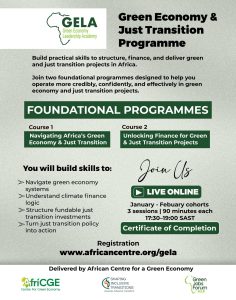
For example, a young entrepreneur in Tanzania’s renewable energy sector could leverage GELA to access training in project finance and connect with regional investors, positioning their solar start-up to scale even amidst decreasing donor aid. Similarly, development agencies in Malawi or Zambia can use GELA insights to design climate-smart agriculture initiatives that align with both national policies and donor priorities.
Conclusion: Adapt, Innovate, and Lead
Africa stands at a critical juncture. Global funding shifts and evolving donor behaviour present real challenges, but they also create opportunities for innovation, localised solutions, and new investment channels. By building skills, strategic insight, and networks, African organisations and professionals can turn uncertainty into opportunity and play a defining role in shaping the continent’s green future. Platforms like the GELA offer a strategic gateway to adapt, lead, and thrive, providing the tools, knowledge, and connections needed to navigate this changing landscape and create meaningful impact in Africa’s green economy.
Author: Kennedy Simango
Research Analyst
