
A month after the Africa Climate Summit (ACS) in Ethiopia, the outcomes of both the Summit and the AfriCGE–SPEDP side event continue to resonate across Africa’s climate ecosystem. The Summit was a landmark for the continent, uniting leaders around the Ethiopian Declaration on Climate Action and Inclusive Green Growth a collective commitment to scale up low-carbon transitions, demand equitable climate finance, and embed inclusivity at the heart of Africa’s green growth.
For the African Centre for a Green Economy (AfriCGE), which co-hosted the side event “Community-Driven Pathways to Just Transitions and Green Jobs in Africa” with the Support for Peace Education and Development Programme (SPEDP), the experience reinforced one of its central convictions: that Africa’s climate transition must be community-led, not consultant-driven.
Elevating Local Voices: Lessons from the Side Event
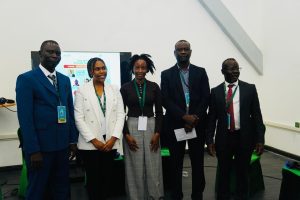
The AfriCGE–SPEDP session brought together a cross-section of practitioners, entrepreneurs, and community leaders who are turning abstract policy goals into tangible change.
- Shameila Reid from Indalo spotlighted township-based green enterprises in South Africa, showing how communities can co-design sustainable solutions that reduce emissions while creating local employment.
- Soro Mike, the CEO of SPEDP shared South Sudan’s approach to linking natural resource management with peacebuilding demonstrating how local environmental stewardship can reduce conflict and restore livelihoods in fragile settings.
- Rose Kobusinge emphasised youth and gender inclusion, underscoring that women and young people are not just beneficiaries but drivers of Africa’s just transition.
Together, these voices painted a vivid picture of how local innovation is already delivering green jobs, resilience, and stability if given visibility, support, and finance. The session also introduced GroFund, a catalytic mechanism designed to channel blended finance into fragile states, addressing one of Africa’s biggest hurdles: risk aversion by traditional investors. This event was more than a discussion; it was a proof of concept that inclusive, community-led transitions are not theoretical, they are happening across the continent.
Linking the Side Event to AfriCGE’s Shaping Inclusive Transitions (SIT) Initiative
The side event’s focus on grassroots pathways directly aligns with AfriCGE’s ongoing Shaping Inclusive Transitions (SIT) Initiative, which seeks to ensure that Africa’s low-carbon transition is equitable, participatory, and grounded in local realities.
As AfriCGE moves into fieldwork in October, the SIT Intiative will carry forward the lessons and voices from Addis Ababa, translating high-level commitments into participatory research and community dialogues in Emalahleni and Ermelo, Mpumalanga. The aim is to listen, document, and co-create locally led solutions that reflect the aspirations and lived experiences of workers, women, and youth affected by the energy transition.
The insights gained from SIT’s fieldwork will not only inform AfriCGE’s policy advocacy at COP30 but also serve as practical examples of how inclusive transitions can take shape from the ground up, linking African communities to the global just transition agenda.
Looking Ahead to COP30: From Declarations to Delivery
The Africa Climate Summit strengthened Africa’s collective voice on climate justice and finance, but its success will ultimately be measured by how effectively these commitments translate into action. For AfriCGE, that means:
- Scaling up community-centred investment models, like GroFund, that de-risk financing for local enterprises.
- Documenting and showcasing locally led innovations emerging from the SIT fieldwork.
- Championing a unified African voice at COP30 that demands not only fair finance but recognition of Africa’s communities as agents of global climate solutions.
As AfriCGE looks ahead, the Africa Climate Summit side event stands as a pivotal bridge between policy and practice, demonstrating how Africa’s green economy transformation must be built from the grassroots upwards.
The coming months will be about deepening that bridge connecting Addis to Mpumalanga, and local insights to global negotiations ensuring that Africa’s climate transition remains not just green, but just, inclusive, and people-driven.
