
In the global race toward climate resilience and sustainable development, conflict remains a stubborn and often overlooked barrier. Across Africa, the intersection of violence, resource scarcity, and environmental degradation is not just a humanitarian crisis, it’s a structural obstacle to a just transition. From South Sudan’s flooded farmlands to the mineral-rich yet volatile terrain of the Democratic Republic of Congo (DRC), the promise of inclusive climate action is being tested in the crucible of conflict.
Conflict as a Climate Multiplier
Ongoing conflicts amplify climate vulnerability in multiple ways:
- Displacement and disrupted livelihoods leave millions without access to land, water, or energy.
- Destroyed infrastructure undermines climate adaptation efforts, from irrigation systems to renewable energy grids.
- Militarized zones often become ecological dead zones, where environmental governance collapses and exploitation thrives.
In fragile states, climate shocks such as droughts, floods, heatwaves don’t just trigger humanitarian emergencies. They deepen existing inequalities, fuel migration, and strain already brittle institutions.
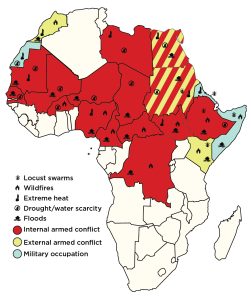
Case Studies: South Sudan, the Sahel, and the DRC
South Sudan
Years of civil war have left South Sudan with one of the world’s highest climate vulnerability indices. Seasonal floods displace hundreds of thousands annually, while armed groups compete over grazing routes and water access. The lack of coordinated climate planning makes adaptation nearly impossible, especially for pastoralist and agrarian communities.
The Sahel
Stretching from Senegal to Chad, the Sahel is a climate hotspot and a conflict corridor. Desertification and erratic rainfall have intensified competition over land and water, fueling intercommunal violence and insurgencies. In Mali and Burkina Faso, extremist groups exploit environmental grievances to recruit and radicalize youth, turning climate stress into a weapon of war.
Democratic Republic of Congo (DRC)
The DRC holds over 70% of the world’s cobalt reserves which are critical for EV batteries and renewable technologies. Yet mining regions are plagued by armed militias, child labor, and environmental destruction. Resource extraction here is not enabling a just transition; it’s entrenching exploitation and ecological harm. Without transparency and community rights, the green economy risks replicating the injustices of the fossil age.
Resource Conflicts and the Just Transition Trap
Minerals, water, and land which are essential for climate adaptation and mitigation are also flashpoints for violence:
- Water scarcity in conflict zones often leads to militarized control and exclusion of marginalized groups.
- Land grabs for carbon offset projects or agribusiness displace Indigenous and local communities.
- Mineral extraction for green technologies can fund armed groups and perpetuate cycles of abuse.
These dynamics create a paradox: the very resources needed for a just transition are being weaponized in unjust ways. Without safeguards, climate action risks becoming another form of extraction and dispossession.
Toward a Peace-Centered Just Transition
A truly just transition must be conflict-sensitive and community-driven:
- Peacebuilding and climate adaptation must be integrated, especially in fragile states.
- Local governance and land rights should be prioritized to prevent resource-based violence.
- Transparency in supply chains, especially for critical minerals is essential to ensure ethical sourcing and community benefit.
International climate finance must go beyond carbon metrics to support resilience, reconciliation, and rights. Africa’s transition cannot be built on unstable ground, it must be rooted in justice, peace, and the lived realities of those most affected.
Author: Allen Kemigisa
Research & Communications Intern
