
South Africa’s Water Crisis: A Structural and Capacity Emergency
South Africa is one of the most water-scarce countries in the world, receiving an average of only 497mm of rainfall annually, nearly half the global average of approximately 860mm. This structural scarcity is compounded by climate change, population growth, urbanisation, and declining infrastructure performance, placing the country under increasing water stress. South Africa is already classified as a water-stressed country, and demand is projected to exceed supply by as much as 17% by 2030 if current trends continue. This crisis is no longer theoretical it is already affecting major population and economic centers. Many areas in Johannesburg and the broader Gauteng region are currently experiencing recurring water outages, with infrastructure deterioration and system inefficiencies reducing supply reliability. Nelson Mandela Bay in the Eastern Cape has faced dangerously low dam levels and ongoing supply restrictions, while eThekwini (Durban) continues to lose more than half of its treated water due to leaks, infrastructure failures, and operational inefficiencies. Cape Town, despite improvements following the 2018 “Day Zero” crisis, remains structurally vulnerable to drought and demand pressures. Rural provinces such as Limpopo and parts of the Eastern Cape continue to face chronic water access challenges, exacerbating inequality and undermining livelihoods. These realities demonstrate that South Africa’s water crisis is not only a resource constraint, but fundamentally a governance, infrastructure, and skills capacity challenge.
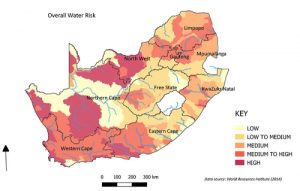
Infrastructure Failure and the Scale of Investment Required
The scale of South Africa’s water infrastructure crisis reflects decades of underinvestment, inadequate maintenance, and declining institutional capacity. Nationally, approximately 46% of water is contaminated with 67% of treatment infrastructure breaking down. Nearly half of treated water is lost before reaching users due to leaks, theft, or system inefficiencies. This represents both a massive resource loss and a financial burden on municipalities. The Department of Water and Sanitation has estimated that South Africa faces an infrastructure repair and maintenance backlog of approximately R400 billion, required to restore and modernise failing water and sanitation systems. However, public funding remains insufficient relative to the scale of the challenge, creating a significant investment gap. Ageing infrastructure, deteriorating wastewater treatment plants, leaking distribution systems, and weak operational management continue to undermine water security. Without significant improvements in both investment and institutional capacity, infrastructure failures will continue to intensify, threatening economic productivity, industrial operations, public health, and long-term development.
Green Skills as a Critical Foundation for Water Security and Scalable Solutions
While infrastructure investment is essential, financial resources alone cannot resolve South Africa’s water crisis without the human and institutional capacity to design, implement, and sustain effective solutions. Green skills including sustainable infrastructure management, climate adaptation planning, resource efficiency, environmental governance, and climate finance literacy are essential for strengthening water resilience. These skills enable practitioners to improve infrastructure performance, reduce system losses, and implement climate-resilient water management strategies. Critically, green skills also enable practitioners to align water resilience projects with the requirements of funders and investors.
Many water infrastructure and climate adaptation projects fail to secure funding not because they lack impact potential, but because they are not structured in ways that demonstrate scalability, financial viability, and credible implementation pathways. The ability to design investment-ready, scalable projects that align with climate finance, development finance, and private sector investment priorities is essential for unlocking the capital needed to address the water crisis. Green skills therefore serve as a bridge between infrastructure needs, institutional capacity, and financial sustainability, enabling solutions to move beyond pilot phases and scale to deliver systemic impact.
Leadership and Skills Development Pathways: The Role of Programmes like GELA
Addressing South Africa’s water crisis requires deliberate investment in leadership and skills development. Programmes such as the Green Economy Leadership Academy (GELA) play a critical role in strengthening the capacity of professionals to design, implement, and scale sustainable water and climate resilience solutions. GELA equips participants with applied knowledge in climate governance, sustainable resource management, and green project structuring, enabling them to translate environmental challenges into practical, implementable interventions.
Participants develop the skills to design projects that are technically sound, financially viable, and aligned with funder and investor priorities, improving their ability to unlock climate finance and infrastructure investment. The programme also strengthens strategic thinking, financial literacy, and implementation capability, enabling participants to structure scalable solutions such as water efficiency programmes, infrastructure rehabilitation initiatives, wastewater reuse systems, and climate adaptation interventions. By focusing on real-world application, GELA ensures that participants are equipped not only with knowledge, but with the practical skills required to deliver measurable outcomes.
Strengthening Institutional Capacity and Unlocking Investment for Water Resilience
South Africa’s water crisis reflects a broader institutional capacity challenge. Infrastructure systems require skilled professionals capable of managing complex technical, financial, and governance processes. Municipalities and implementing institutions often lack sufficient expertise to structure projects, manage infrastructure effectively, and align initiatives with investment opportunities. Strengthening green skills and leadership capacity enables institutions to design scalable, investment-aligned solutions that attract funding and deliver sustainable outcomes. Programmes like GELA help bridge the gap between infrastructure needs and investment readiness by equipping professionals with the ability to align projects with climate finance and development finance requirements. This strengthens South Africa’s ability to mobilise funding, improve infrastructure performance, and implement long-term water resilience strategies.
Building the Green Skills Needed to Secure South Africa’s Water Future
South Africa’s water crisis represents one of the most significant infrastructure and sustainability challenges facing the country today. With nearly half of municipal water lost through system inefficiencies, a R400 billion infrastructure backlog, and major cities already experiencing supply instability, strengthening institutional capacity and green skills is essential. Investing in green skills and leadership development through programmes like GELA provides a critical pathway for addressing this crisis. By equipping professionals with the ability to design scalable, fundable, and implementable water resilience projects, these programmes strengthen South Africa’s capacity to unlock investment, improve infrastructure performance, and ensure long-term water security. Ultimately, green skills are not only an environmental priority, but a strategic economic and institutional necessity for building a resilient, sustainable, and water-secure future.
Authors: Kennedy Simango (Research Analyst) and Allen Kemigisa (Communications & Research Intern)
